Security is where the airport's rules meet your prep - and where the traveler who packed carelessly pays for it in delay. The rules are mostly consistent across major countries, with important exceptions, and the mechanics of a fast screening are almost entirely under your control.
What screening actually checks for
Airport security screens for weapons, explosives, and prohibited items. The x-ray machine images your bag and shows density; the walk-through detector or millimeter-wave scanner images your body for concealed objects. Bags are usually run through a second higher-resolution machine if the first flags anything unusual. The whole process is designed to keep the line moving; the person behind you is why the screener takes ten seconds, not two minutes.
The liquids rule
The 100 ml / 3.4 oz per container rule applies across the US, EU, UK, and most of the world. All liquid containers must fit inside a single one-quart or one-liter transparent resealable bag, with no restrictions on the number of bags per traveler in some jurisdictions and one bag per traveler in others. Liquids include gels, creams, aerosols, and foods with liquid content (yogurt, honey, hummus, salsa).
Exceptions: medically necessary liquids (declared to the screener), infant formula and baby food (declared), and liquid duty-free purchased inside the airport in a sealed tamper-evident bag with receipt. If you're going through a second security check on a connection, duty-free liquids purchased at the previous airport may still be confiscated - check the transit airport's rules.
Electronics
Laptops and tablets larger than a phone traditionally have to come out of your bag for x-ray. Newer scanners at some airports (LAX, Amsterdam, Heathrow, most of Asia's major hubs) allow laptops to stay in bags - signage at the checkpoint will tell you. When in doubt, take them out.
Lithium batteries, e-cigarettes, and power banks must fly in your cabin, never checked. If you're pulled aside for a battery check, be prepared to identify the wattage-hour rating of any large power bank; ratings above 100 Wh may be prohibited entirely.
Clothing and body
Standard practice at most Western airports: remove jackets, belts with metal buckles, and shoes that could conceal items (boots, heavy sneakers). Metal jewelry usually stays on; large metal accessories should come off. Empty your pockets entirely - wallets, phones, keys, receipts, coins - into a bin.
TSA PreCheck and equivalents (Global Entry, NEXUS, SENTRI, and now EU-based programs) keep shoes and jackets on and laptops in bags. If you travel internationally more than twice a year and are eligible, the trusted-traveler application is worth the time.
The most-forgotten items
Items that get confiscated most often, in order: bottled water (fill an empty bottle after security instead), snow globes (yes, they count as liquid), oversized peanut butter jars, imitation firearms and toy guns, tools longer than 7 cm, and multi-tools with knife blades. Fireworks, most sports darts, and certain sports equipment are prohibited outright.
The connection screening trap
Connecting internationally sometimes requires re-screening. On flights that route US→international→US, expect a full re-screening on the return leg. On some Asian and European connections, you stay in the sterile transit zone and skip re-screening. On others (especially arrivals into the US, Canada, and Australia from any origin), you clear customs, collect bags, re-check bags, and re-clear security. Know your itinerary.
Medications and medical devices
Medications should always fly carry-on and stay in original labeled containers. Liquid medications above 100 ml are allowed but should be declared at the checkpoint. CPAP machines, insulin pumps, and other medical devices can go through x-ray or be inspected manually by request. A brief note from your doctor for controlled or unusual medications smooths any question.
What triggers a secondary screening
Random selection accounts for a portion of secondary screenings; the rest are triggered by machine flags. Common triggers: dense objects in bags (books stacked on batteries can look strange), organic residue on hands (from certain hand creams and lotions), and unusual metal patterns from clothing. A secondary screening is rarely a problem; it's a minute or two of extra time and a swab test. Cooperate calmly.
The three-bin strategy
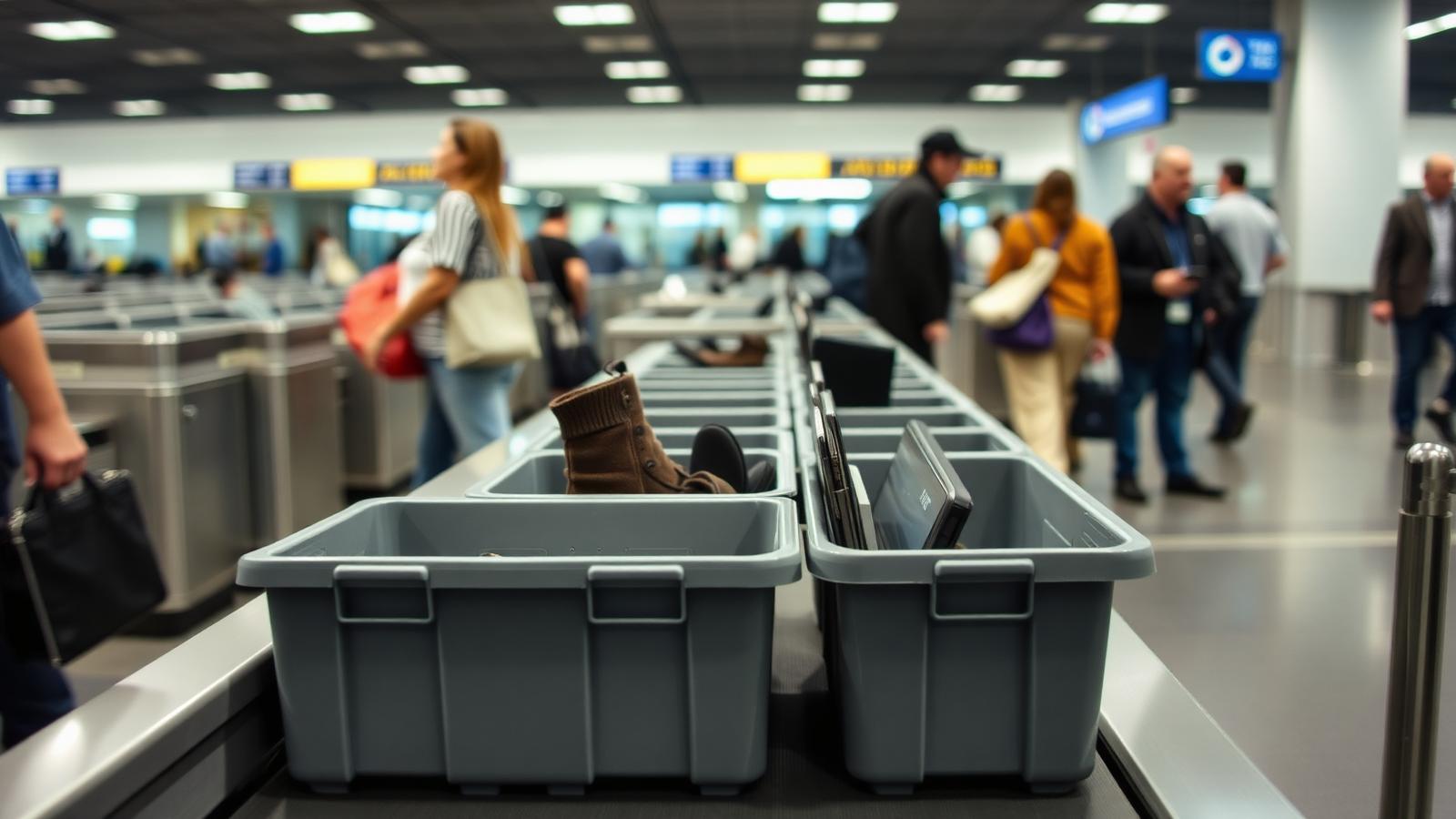
Fast screening at a modern checkpoint takes exactly three bins: bin one for jacket, shoes, and belt; bin two for laptop and liquids bag; bin three for the carry-on itself, or the carry-on goes on the belt directly. If you can pre-sort your pockets before the belt (phones, keys, coins into a small pouch in your bag while waiting), the whole operation takes 90 seconds.
One habit that saves the most time
The single habit that most speeds security: wear slip-on shoes for the flight. Boots and complicated laces are the biggest single delay at most checkpoints. The traveler who spends 20 seconds putting shoes back on holds up ten travelers behind them; the one in loafers is out of the checkpoint before their laptop bag is repacked.
Real destinations where this applies
- Amsterdam Schiphol (AMS) - Newer scanners let laptops stay in bags; signage marks the lanes.
- Singapore Changi (SIN) - Fastest large-airport security in the world by average traveler minute.
- Los Angeles (LAX) - Terminal-to-terminal variation is significant; PreCheck lanes save meaningful time.
- Frankfurt (FRA) - Connecting from non-Schengen origins re-runs full security - allow extra time.
Map
Travel tips
- •Wear slip-on shoes on flight days.
- •Pre-sort pockets into a pouch before you reach the belt.
- •Fill your water bottle after security, not before.
- •Keep the liquids bag at the top of your carry-on for easy access.
- •Apply for trusted-traveler status if you fly internationally more than twice a year.
Common mistakes to avoid
- ✕Forgetting to remove the water bottle you filled outside the airport.
- ✕Packing a multi-tool with a blade in carry-on.
- ✕Checking a laptop or power bank in a bag going to the hold.
- ✕Wearing complicated boots on flight day.
- ✕Assuming duty-free liquids will pass a second checkpoint.
Frequently asked questions
Can I bring food through security?+
Solid food yes; liquid or gel-based food is subject to the 100 ml rule. Peanut butter and yogurt count.
Is TSA PreCheck worth it?+
For any traveler flying more than 4-6 times a year within or from the US, almost always yes. Global Entry includes PreCheck and international expedited entry.
What happens if I forget to declare medication?+
Usually nothing - but declaring proactively speeds the process and prevents any awkwardness at destination customs.
Can I be denied boarding for something found at security?+
Not for a routine confiscation. Serious findings (weapons, drugs) trigger a different process and potential legal consequences.
Elena is IST World's senior planning editor, based in Lisbon. She writes about the practical mechanics of getting from one gate to another with your sanity intact.