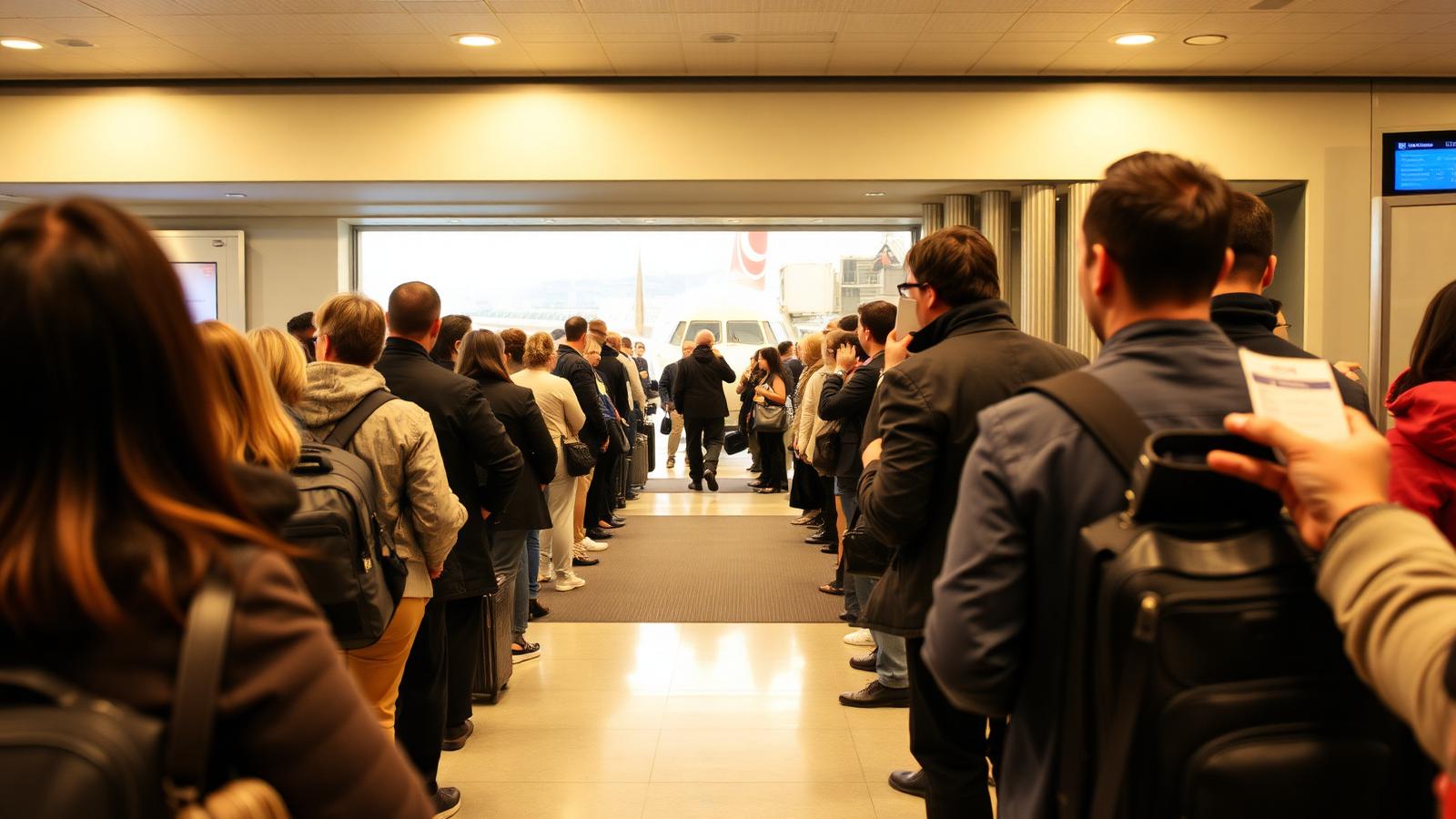
Boarding looks chaotic and is actually one of the most tightly choreographed parts of the airport day. Every airline has its own group system, its own priority order, and its own quirks about carry-ons and gate-checked bags. Understanding the mechanics makes the difference between boarding calmly with your carry-on beside you and boarding last with your bag in the hold.
When boarding actually starts
Boarding for international flights typically opens 45-60 minutes before scheduled departure and closes 10-20 minutes before pushback. Domestic boarding opens 30-45 minutes before departure. These times are not suggestions; miss the closure and you miss the flight, even if you're standing in the terminal.
Some airlines board in waves; others open the door and let everyone flow. Announcements at the gate are the source of truth. Sit close enough to hear them - the app notification is not always reliable, and the gate agent's actual practice at a specific gate on a specific day is what determines when the door closes.
Group order across major carriers
Most airlines board in a similar sequence, though the labels differ: passengers needing assistance and families with young children first, then first class, then business class, then top-tier elite status, then remaining elite tiers, then premium economy, then main-cabin priority (based on fare bucket or credit-card holders), then general economy in groups (usually 3-5 groups defined by row or class of fare).
The two most valuable tiers for a traveler without status: airline credit cards that grant priority boarding, and paying for a fare with priority boarding included. Both usually get you into the first main-cabin group, which is when overhead bin space is still available at your seat.
Bin space: the real reason boarding order matters
The single biggest reason to board earlier is overhead bin space. Modern narrow-body aircraft (737, A320 families) do not have enough bin space for every passenger's full carry-on plus personal item. When bins fill, the airline gate-checks remaining carry-ons for free. Your bag goes to the hold; you retrieve it at baggage claim with the checked bags.
This is the single most preventable delay at the destination. Board with the first group that has bin access, put your bag directly above your seat (not two rows back), and put only your personal item in the seat back or floor space.
Zones and their quirks
Some airlines board zones back-to-front, others window-middle-aisle. The best-boarding airlines board by seat position first, then by row, which minimizes aisle bottlenecks. The worst boarding is a free-for-all that fills the aisle and stops the process cold. Nothing you do at the gate changes this, but knowing your airline's system tells you when to stand up.
Priority boarding for a fee
Most airlines now sell priority boarding as an add-on at check-in for $10-25. It is worth it exclusively for the bin space, not the extra minutes on the plane. If you're traveling with a large carry-on and no status, it's usually the best-value airline upsell.
Pre-boarding and families
Families with children (age limits vary from under 2 to under 6 depending on carrier), passengers with disabilities, passengers needing assistance, and unaccompanied minors board before general boarding. Traveling with a small child gives you meaningful bin-space advantage; use it.
Gate-checking: when it happens and what to do
Gate check happens in three cases: bins fill and later boarders lose overhead space, strollers and car seats routinely gate-check on family flights, and any bag deemed too large at the gate is tagged for the hold. If your bag is gate-checked, remove valuables, electronics, and medications before you hand it over. Photograph the bag as you hand it off in case it goes missing.
Missing your boarding call
Boarding closes 10-20 minutes before departure. Once the door is closed, it does not reopen. If you're at the airport but not at the gate, you can still miss the flight. Two habits: be at the gate 45 minutes before departure for international, and don't rely on gate announcements over the terminal PA - they don't always work.
Boarding disputes
The gate agent's decision is final and does not benefit from argument. If you believe you were denied boarding incorrectly, take the alternative offered, note the details, and pursue the complaint later with the airline. The gate is not the venue for a resolution.
The last minutes before push-back
Once seated, put phone on airplane mode, review the safety card if you're new to the aircraft type, and settle in. Cabin crew will do a final walk-through checking seatbelts, closed bins, and stowed items. Push-back typically happens within five minutes of doors closing. From here, the airline runs the show.
One habit that solves 90% of boarding problems
The single habit that eliminates most boarding stress: be at the gate 45 minutes before departure, in the boarding group's line queue when your group is called, with your boarding pass and passport ready in one hand. Nothing about boarding is complicated when you're early. Everything about it becomes complicated when you're late.
Real destinations where this applies
- Amsterdam Schiphol (AMS) - KLM's zone-based boarding is one of the most orderly systems in Europe.
- Chicago O'Hare (ORD) - United's group system heavily rewards status and credit-card priority.
- Tokyo Haneda (HND) - JAL and ANA board with meticulous precision - a benchmark for the industry.
- Frankfurt (FRA) - Lufthansa's boarding often uses buses for remote stands; timing matters more here than at gate boarding.
Map
Travel tips
- •Be at the gate 45 minutes before international departure.
- •Board with the first group that has bin access - buy priority if needed.
- •Put your bag directly above your seat, not further back.
- •Move valuables to your personal item before gate-checking.
- •Trust gate announcements more than app notifications.
Common mistakes to avoid
- ✕Waiting to board last on a full flight - bins will be gone.
- ✕Standing in the aisle looking for space instead of putting the bag above your seat.
- ✕Missing boarding while at another gate or a lounge without a boarding-call notification.
- ✕Arguing with the gate agent at closure time.
- ✕Assuming digital boarding passes always work - a printed backup helps.
Frequently asked questions
When does boarding close?+
10-20 minutes before scheduled departure on most airlines. Once the door closes it does not reopen.
Is priority boarding worth the fee?+
Almost always, if you have a carry-on you want to keep with you. Bin space is the real reason.
What if I miss boarding?+
You're re-booked on the next available flight, usually at your cost unless the miss was the airline's fault.
Can I board out of my assigned group?+
Not without gate agent permission. Attempting to board early is called 'gate-jumping' and can result in being sent back or denied boarding.
James is a former airline ground operations lead and IST World's airports editor. He has closed boarding at every kind of gate.