Most packing advice online is a list of items. That is the wrong end of the problem. The reason a bag is too heavy or a traveler is under-dressed for dinner in Florence is almost never a missing item - it is a missing system. Before you pull anything from a closet, you need three decisions: how many outfits, in what climates, worn how many times before laundry. Get those three answers and the packing list writes itself.
This guide walks through a packing method used by professional travel writers who file from the road with one carry-on. It works for a five-day trip to Barcelona and it works for a six-week reporting trip through Southeast Asia. The math changes; the framework does not.
The 5-4-3-2-1 rule for one week
For any trip of a week or shorter, the baseline packing target is 5 tops, 4 bottoms, 3 pairs of shoes at most (worn one, packed two), 2 outer layers, and 1 formal or evening piece. That is the entire clothing volume. Everything else is toiletries, electronics, and documents. If your list exceeds 5-4-3-2-1 you should be able to name the specific activity that requires the excess - a black-tie wedding, a multi-day trek, a diving certification. If you cannot name it, cut it.
The rule scales linearly for longer trips only up to about 12 days. Past that, laundry becomes cheaper than luggage. In Tokyo, Lisbon, or Cape Town, a hotel laundry service or a coin laundromat can turn a week's clothes into two weeks for the price of one dinner. Build a laundry day into any trip over ten days and your bag stays the same size.
The one-color palette trick
Every piece in your bag should work with every other piece. The fastest way to guarantee this is a two-color base plus one accent - for example, navy and cream with a rust accent, or black and grey with a burgundy accent. Every shirt, sweater, and jacket should combine with every pair of trousers. If any single item only works with one other, remove it. This is the difference between packing five tops and having twenty possible outfits or packing five tops and having six.
The palette rule also solves the biggest photographic complaint travelers have: 'I don't look like myself in the photos.' You do - you just look like yourself in five different clothing accidents. A coordinated palette photographs as a consistent identity, which is a small aesthetic gift you give your future self.
Roll, don't fold - but only cotton
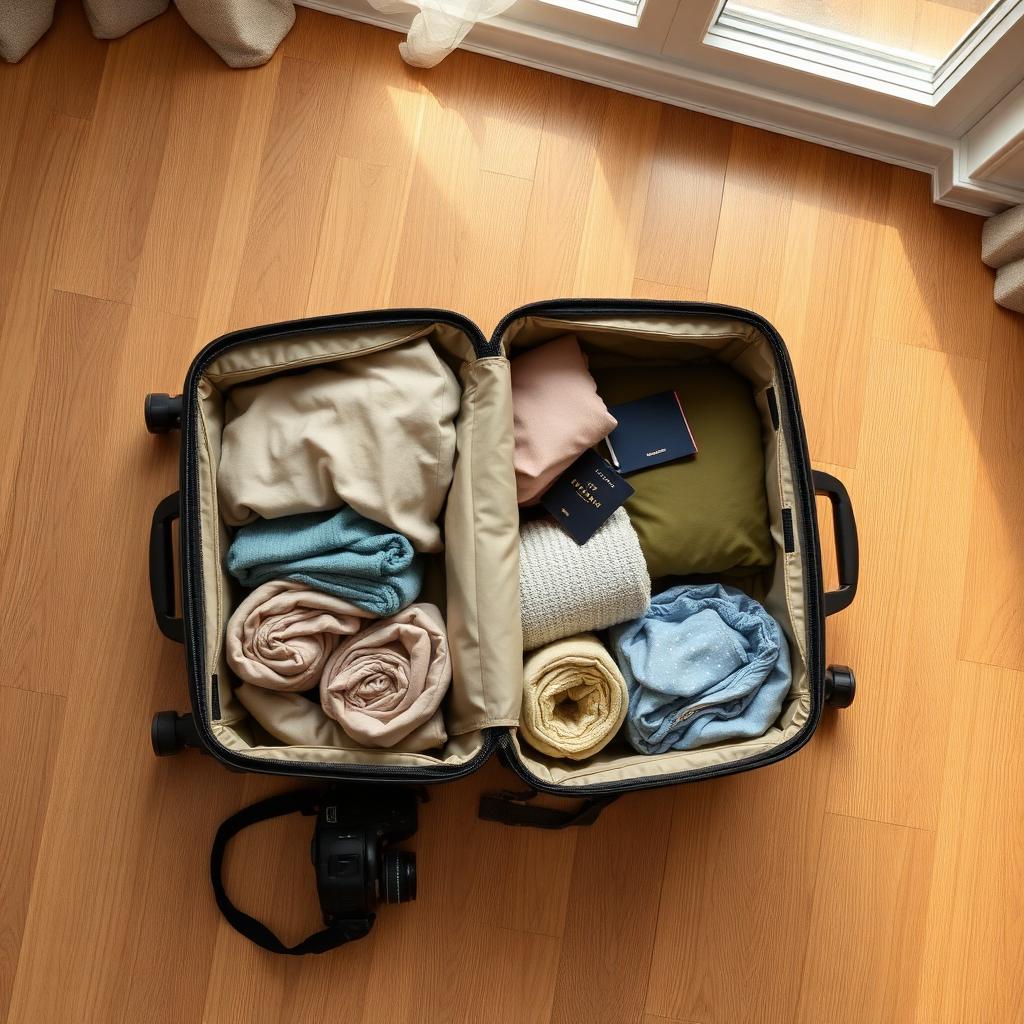
Rolling saves 30-40% of volume compared to folding, but it also creates set-in wrinkles in structured fabrics. Roll cotton t-shirts, underwear, socks, jeans, and casual dresses. Fold linen shirts, wool trousers, suit jackets, and anything with a lining. Structured pieces belong flat at the bottom of the bag with rolled items packed on top; the weight of the roll flattens the fold and prevents creasing.
Compression sacks, popular in the ultralight backpacking community, are usually overkill for city travel. They compress but do not organize, and the release of pressure at the destination guarantees a wrinkled first day. Packing cubes solve organization without compression trauma.
The one-bag electronics kit
Every traveler underestimates cable clutter. A small mesh pouch containing your charger, one universal adapter, a short USB-C cable, a longer backup, and headphones will save you fifteen minutes at every hotel room. If you carry a laptop, add a compact power bank rated at 10,000 mAh - enough to fully charge a phone twice - and skip the redundant chargers. One good charger is worth three cheap ones you'll forget in different hotels.
Label every cable with a piece of masking tape and your first name. It sounds excessive; it will not the first time you leave one behind at a hostel and get it back.
The toiletries reality check
You do not need to bring your full home bathroom to Rome. Rome sells shampoo. So does Bangkok, Buenos Aires, and Reykjavík. Bring only what is genuinely hard to buy at the destination - prescription medication, contact lenses if you wear them, a specific brand you cannot function without. Anything else, buy on arrival in a smaller size. A single trip to a supermarket in the first 24 hours will save you 500 grams of luggage and give you an unhurried excuse to see the neighborhood.
One exception: hotels above three stars almost always provide shampoo, conditioner, and shower gel. Hotels below three stars often do not. If you have booked hostels, guesthouses, or Airbnbs, bring the essentials in TSA-compliant 100ml bottles. If you are staying in mid-range hotels, skip them entirely.
The 'first 24 hours' bag inside the bag
Inside your carry-on, pack a small pouch with everything you need for the first 24 hours if your checked bag is lost. A change of underwear, a change of shirt, your toothbrush, phone charger, medication, a granola bar. If the bag arrives, you have not lost anything. If it doesn't, you have bought yourself a calm evening instead of a frantic taxi ride to a chain store.
The same pouch is what you use for your first shower after a red-eye and for the second night's outfit if you had a long transit day. It becomes the bag you actually live out of for the first two days of the trip.
What to leave at home
The 'just in case' item is the one that never gets used and always adds weight. If you have not worn a piece in the last month at home, you will not wear it on the trip. If a shoe is not comfortable for a two-hour walk in your neighborhood, it will not become comfortable in Kyoto. Books, in almost every case, should be replaced with a Kindle or a phone e-reader. A physical guidebook is nice; three of them is a workout.
Also leave: expensive watches, sentimental jewelry, a second wallet, and hair tools if the destination uses different voltage. Curling irons are the most-often-fried item in Europe.
The night-before packing session
Do not pack the morning of. Pack two nights before. Give your unconscious mind a full day to notice what you forgot. Lay everything out on a bed - clothes, toiletries, electronics, documents - and photograph it. This becomes your reference if you ever file a lost luggage claim. Then load the bag, weigh it if you have a hand scale, and adjust.
The best packing is invisible. You should not think about your bag once during the trip except when you're opening it. If you notice your bag - because it's heavy, because you can't find something, because the wrong item is on top - that is a system failure to correct on the next trip. Iteration is what turns a good packer into a great one.
Real destinations where this applies
- Kyoto, Japan - Coin laundromats are common and cheap in every neighborhood - the 12-day laundry break is easy to build in.
- Lisbon, Portugal - Cobbled hills demand real walking shoes; a fashionable pair without support becomes a mistake fast.
- Marrakesh, Morocco - Dust in the medina is unavoidable - pack darker colors and a rinse pouch for laundry sink-washes.
- Reykjavík, Iceland - Layer weather changes hourly; three thin layers beats one thick coat every day of the year.
Map
Travel tips
- •Weigh your bag with a $10 luggage scale before you leave the house - most airlines charge more for one kilo over than the scale costs.
- •Wear your heaviest shoes and coat on the plane, not in the bag.
- •Freeze a small ziplock of water; it doubles as ice for a first-night drink and passes through security as a solid.
- •Pack a spare set of AirPods tips or foam covers - the small ones vanish in hotel sheets constantly.
- •Screenshot your packing list and share it with a travel partner; joint audits catch redundancies.
Common mistakes to avoid
- ✕Packing the 'trip you imagine' instead of the 'trip you booked' - five swimsuits for a city trip that includes one pool day.
- ✕Bringing new shoes without breaking them in for at least ten miles of walking at home.
- ✕Underestimating the weight of chargers, adapters, and cables - a single mesh pouch of electronics can hit 900 grams.
- ✕Not testing the outfit for the fanciest night of the trip in advance.
- ✕Assuming laundry will be available and then finding out the hotel's is priced per garment.
Frequently asked questions
How much should a full carry-on weigh?+
Aim for under 8 kilos (17.6 pounds). Most European carriers enforce this strictly; most North American carriers do not weigh cabin baggage, but a heavier bag is harder to lift into an overhead bin.
Do packing cubes really save space?+
They save organization, which indirectly saves space by making overpacking visible before you close the bag. Compression cubes save an additional 15-20% of volume at the cost of slower repacking.
What's the single most-forgotten item?+
In our reader surveys, the tie is between phone chargers and prescription medication. Both go in the electronics pouch, not the toiletries kit.
Should I pack a first-aid kit?+
A small one - bandages, painkillers, anti-diarrheal, blister plasters. Anything more should be scoped to the destination (e.g., altitude medication for La Paz).
Priya is IST World's gear and packing editor, based in Bangalore. She has tested carry-on systems on every continent except Antarctica and firmly believes in the 5-4-3-2-1 method.